
Media wall planning
Not every room suits a media wall. That does not mean you cannot have one. It means the layout, size, and features need to match the space. This checklist helps you decide if your room is suitable before you plan anything.
Why room suitability matters
Most media wall problems are not build issues. They start earlier, when the room is not assessed properly. TVs end up too high, walkways feel tight, or heat builds up where it should not.
A media wall should make a room feel more settled. If it dominates or restricts how you move, the room was not ready for that design.
Checklist 1: Do you have enough wall space?
Start with the simplest question. Do you actually have a usable wall, not just an empty one?
Is the wall free from doors, radiators, or large windows?
Can you centre the TV without pushing it into a corner?
Is there enough width to frame the TV, not just squeeze it in?
A narrow wall often leads to a tall, boxy media wall that feels top-heavy. This is one of the most common layout regrets.
Checklist 2: Seating distance and viewing comfort
Media walls are built around how you watch TV. Measure from your main seat to the wall.
Can the TV sit at or near eye level when seated?
Will the screen size match the viewing distance comfortably?
Can everyone see the screen without twisting or leaning?
If you are unsure, revisit: media wall size planning before fixing the layout.
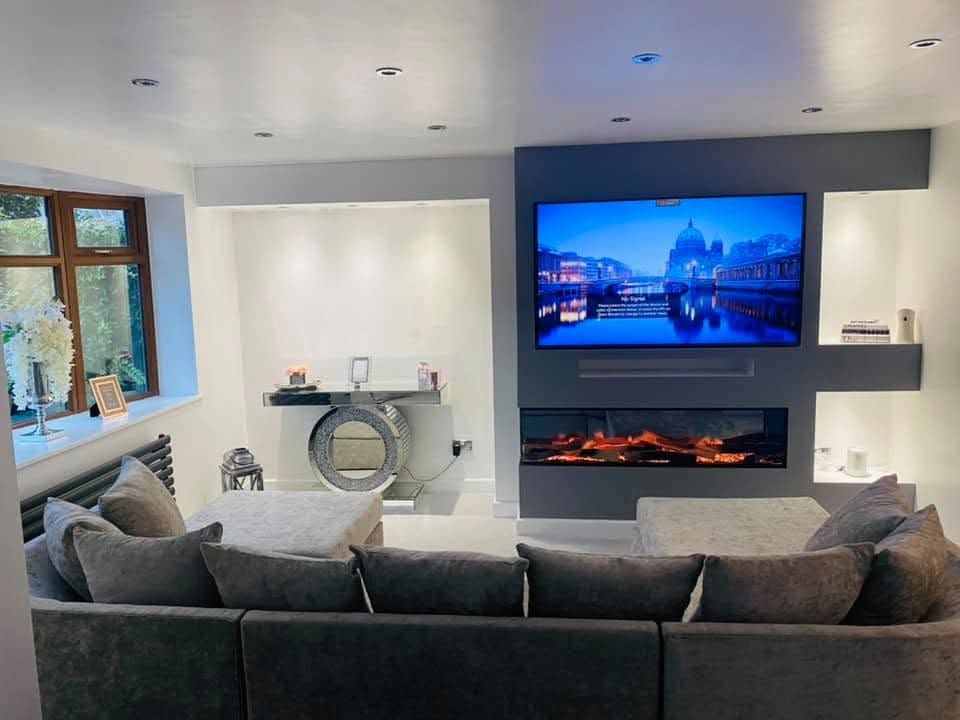
Checklist 3: Depth and walkways
Media walls project forward. Even slim designs reduce usable floor space.
Will walkways still feel clear once the wall is built?
Do doors or cupboards open fully?
Is there space for seating without crowding the room?
In smaller rooms, shallow designs often work better than full-depth feature walls. Storage can move sideways rather than forwards.
Checklist 4: Power, data, and wiring
If the room cannot support the wiring cleanly, the finished wall will always feel compromised.
Are sockets positioned where the TV and soundbar will sit?
Is there space for data, aerial, or streaming connections?
Can cables be hidden without surface trunking?
This links directly to: planning sockets and wiring and hiding cables.
Checklist 5: Heat and airflow
Heat changes everything. TVs, soundbars, and fireplaces all generate it.
Is there space for airflow behind electronics?
If adding a fireplace, can clearances be met?
Will heat build up in enclosed shelves?
Ignoring airflow leads to overheating, cracked finishes, and shortened equipment life.
If heat feels like a compromise, review: fireplace or no fireplace before committing.
Checklist 6: Storage needs
Media walls often replace TV units. That storage has to go somewhere.
Where will consoles, routers, or media boxes live?
Do you want hidden cupboards or open shelving?
Can storage be accessed without dismantling the wall?
Storage planning is covered in: media wall storage solutions.

Checklist 7: Lighting and glare
Lighting affects both comfort and screen visibility.
Does daylight hit the screen directly?
Will downlights reflect in the TV?
Is there space for soft accent lighting?
Lighting choices are often finalised late, but they should be considered early in the layout.
Checklist 8: Room balance and proportions
A media wall should match the scale of the room. Oversized designs make small rooms feel closed in.
Does the wall leave breathing space elsewhere?
Does furniture still sit comfortably?
Does the wall feel like a feature, not a barrier?
In compact rooms, simpler designs often feel better long term. Not every wall needs shelves, fires, and lighting all at once.
FAQ
Can small rooms still have media walls?
Yes. The design just needs to be scaled back. Slim depth, careful TV sizing, and minimal features work best.
What is the biggest sign a room is not suitable?
When TV height, seating comfort, and walkways all feel compromised. If you cannot solve those three, rethink the design.
Should I plan the room before choosing the TV?
Ideally yes. TV size, viewing distance, and wall layout work together.
Use the checklist before you build
This checklist helps you spot issues early, when they are easy to fix. Once a wall is built, compromises become permanent.
View TV media wallsUseful next reads: Media wall cost guide, DIY vs professional install.