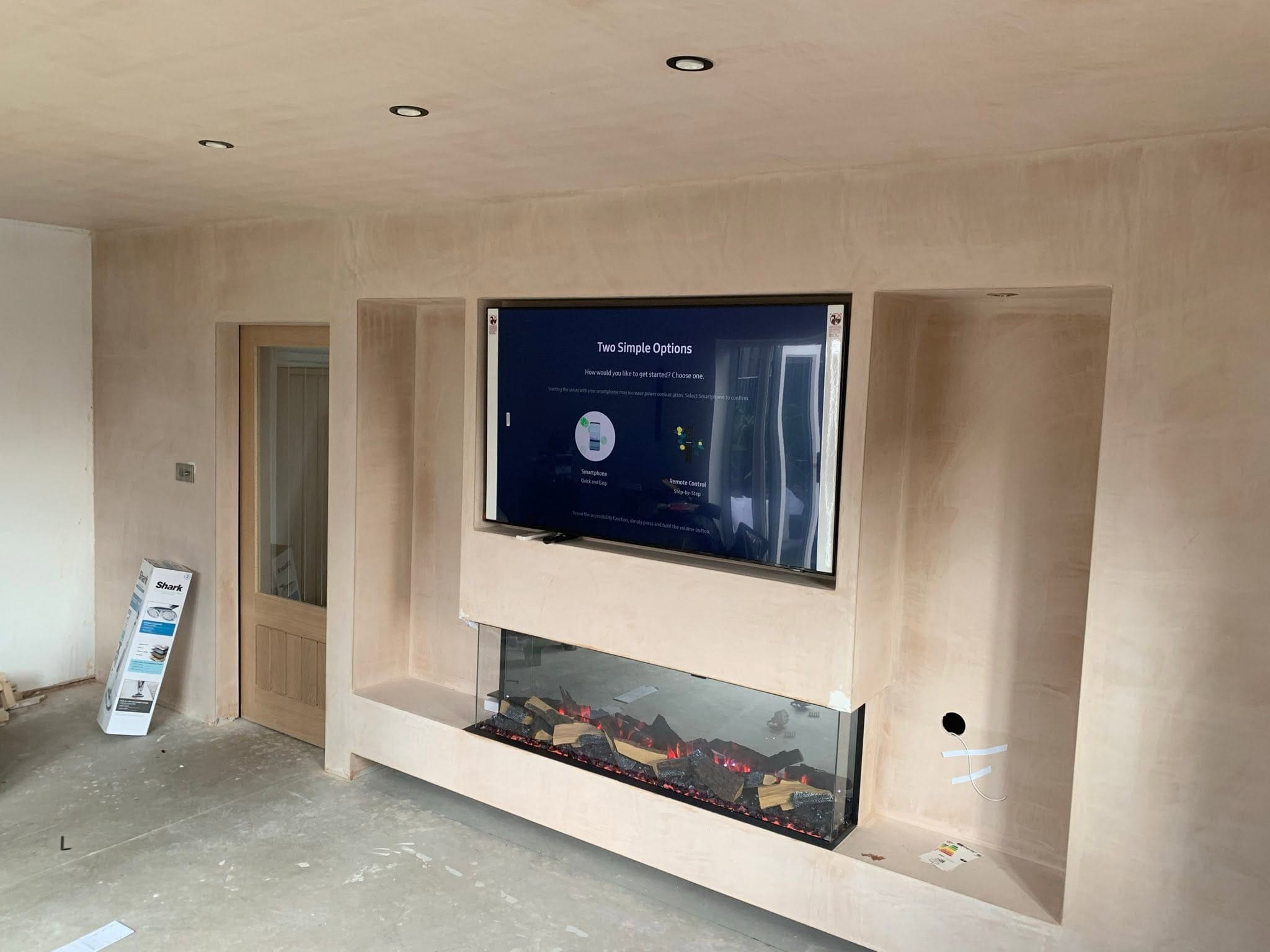
Media walls remain one of the most requested home improvement projects in the UK — and in 2026, the designs have moved on significantly. Homeowners are moving away from the heavily contrasted feature walls of a few years ago and towards more considered, material-led builds that feel custom rather than off-the-shelf. Whether you’re planning from scratch or refreshing an existing wall, here are the trends defining media wall design in 2026.
1. Fluted Panels and Ribbed Textures
Fluted MDF and ribbed wall panels have become the defining surface material of 2026 media walls. Where split-face tiles and venetian plaster dominated previous years, fluted panels offer a cleaner, more contemporary look that photographs well and ages gracefully. They work equally well in natural oak tones, painted finishes, and mono-colour schemes.
The appeal is practical as well as aesthetic — fluted panels are easier to install than tiling, can be cut to precise dimensions, and hide joins cleanly. Combined with integrated strip lighting positioned behind or within the channels, they create a depth effect that makes a standard chimney-breast alcove feel purpose-built.
See how textured surfaces work alongside fireplace integration on our Integrated Fireplace page.
2. Tonal and Mono-Colour Media Walls
The high-contrast media wall — white wall, dark surround, different colour alcoves — is giving way to tonal builds where the entire wall, cabinetry, and even ceiling coving use the same colour family. Deep greens, warm greys, dusty plasters, and off-blacks are the most requested shades in 2026.
The result is a wall that reads as a single architectural feature rather than a collection of components. This approach works especially well in open-plan living rooms where the media wall needs to anchor the space without competing with other design elements.
For colour ideas and finish combinations, visit our Media Wall Colour Ideas guide.
3. Full-Height Media Walls
Ceiling heights have become a genuine selling point, and the media walls taking advantage of them are the ones generating the most interest in 2026. Running a media wall from floor to ceiling — with the TV centred, integrated storage flanking it at lower height, and open shelving or panelling rising to the ceiling above — creates a proportion that standard builds can’t match.
This is particularly popular in new builds and extended Victorian terraces where ceilings have been raised. The key to making it work is treating the upper section as a design element rather than an afterthought: recessed LED strips, decorative niches, or continued panelling all prevent the wall from feeling unfinished above the TV zone.
4. Minimalist Media Walls
The minimalist approach hasn’t faded — it’s refined. In 2026, the focus is on fewer elements done better: a single large-format panel, a push-to-open cabinet with no visible handles, a slim integrated fire, and nothing that draws the eye without purpose. The TV is often flush-mounted or recessed rather than sitting proud of the surface.
Neutral palettes — warm whites, concrete greys, natural limewash — continue to define this category. The difference from previous years is that the minimalism now extends to the cable management and socket placement, with both designed into the build from the start rather than managed retrospectively.
Browse our TV Media Walls page for examples of clean, minimal builds.
5. Smart and Integrated Lighting
Lighting is no longer a finishing touch — it’s part of the structural brief. The most-requested lighting setups in 2026 combine recessed ceiling spots above the wall with strip lighting inside alcoves, behind panels, or within the fireplace surround, all running from a single smart controller.
App and voice-controlled lighting (Philips Hue, Lutron, and Casambi are the most common systems used in installations) allows different scenes for different uses: a bright working environment, a warm evening setting, or a purely ambient mode with the TV off. Where this differs from earlier smart features is that the wiring is now planned at first-fix stage rather than added later.
See our LED Lighting Options guide for the full breakdown, and our Socket and Wiring Planning page for first-fix considerations.
6. Media Walls Without a Fireplace
Not every build needs a fire. In 2026, media walls without integrated fireplaces are increasingly popular — particularly in urban apartments, new builds with underfloor heating, and rooms where a fireplace has already been removed. The space where a fire would sit is instead used for a deep TV recess, a statement panel section, or low-level storage with feature lighting.
The design challenge is creating a visual anchor where the fireplace would normally sit. Solutions include a large-format niche, a sculptural panel insert, or a flush storage unit at the same depth as the TV recess — all of which work well with fluted or textured surfaces.
Read more in our dedicated Media Wall Without Fireplace guide.
7. Multi-Functional Builds with Integrated Storage
Storage has always been part of the media wall conversation, but in 2026 the specification has become more detailed. Push-to-open base units, floating shelves at precise heights for specific tech, and drawer units with internal cable routing are now standard asks rather than premium additions.
The most functional builds treat storage as a solved problem: cables enter the wall at first fix, devices sit in ventilated enclosures, and the entire front face is clean when the doors are closed. This approach is particularly popular in alcove builds where the depth of a chimney breast allows genuinely useful storage on either side of the fire or TV.
For alcove-specific ideas, see our Media Wall Alcove Ideas page.
8. Sustainable Materials and Low-Impact Builds
Environmental considerations are a more active part of the brief in 2026 than they were a few years ago. Clients are asking specifically about recycled MDF content, VOC levels in paints and primers, and the energy consumption of integrated fires. Low-energy LED systems and A-rated electric fireplaces are now standard specifications rather than optional upgrades.
Reclaimed timber for shelving and decorative inserts, limewash plaster finishes (which use significantly less material than conventional renders), and locally-sourced panels are all part of the sustainability conversation. These choices don’t compromise the finished look — in many cases, the material quality is higher.
How to Apply These Trends to Your Own Build
Start with the surface material: Whether it’s fluted panels, limewash plaster, or painted MDF, the surface drives every other decision including colour, lighting, and hardware.
Plan cables and sockets at first fix: Every trend in 2026 depends on hidden cable management. Do this before any boarding goes up.
Choose a lighting scene, not just a fitting: Decide what the wall should look like in three modes (daytime, evening, off) and specify the lighting system to match.
Decide early on fireplace vs no fireplace: The structural approach to both is different enough that it’s worth committing to before any design work begins.
Match scale to the room: Full-height walls work in rooms with 2.5m+ ceilings. In standard new builds, a well-proportioned mid-height build often looks better than stretching to the ceiling.
Frequently Asked Questions
What are the most popular media wall materials in 2026?
Fluted MDF panels, limewash plaster, and painted board-and-batten are the three most requested finishes in 2026. All three work with integrated lighting and suit both minimalist and feature-led designs.
How much does a media wall cost in 2026?
A professionally installed media wall in the UK typically costs between £2,500 and £8,000 depending on size, materials, and whether a fireplace is included. For a detailed breakdown, see our Media Wall Cost Guide.
Do media walls work in small rooms?
Yes — with the right design. The key is keeping the build shallow and using the wall to create the impression of depth rather than consume floor space. See our Media Wall Ideas for Small Rooms guide for specific approaches.
Can I have a media wall without a fireplace in 2026?
Absolutely. Many of the best builds this year don’t include a fire. The space is used for a deep TV recess, feature lighting, or storage instead. See our Media Wall Without Fireplace page for design ideas.
How long does a media wall installation take?
Most installations take 3–5 days depending on complexity. A build with integrated wiring, custom cabinetry, and a fireplace will take longer than a straightforward panel and TV build. First-fix wiring adds a day at the start of the project.
Ready to Plan Your 2026 Media Wall?
Whether you’re drawn to fluted panels and tonal colour schemes, or you want a clean minimalist build with a slim integrated fire, the team at Media Wall Master designs and installs across Sheffield and South Yorkshire. Get in touch for a no-obligation consultation and site visit.