
Planning a media wall in a corner? It comes up in almost every enquiry we get — and the answer is yes, it can absolutely be done. Corner builds do require a bit more thought than a standard flat wall, but done right they can become a proper focal point in the room. Here’s everything you need to know before getting a quote.
Whether you’re working with a natural alcove in a corner, an L-shaped living space, or simply want to make better use of a corner wall, this guide covers the design options, the structural considerations, and what to expect from the build.
Can you put a media wall in a corner?
Yes — corner media walls are completely achievable, but they’re more involved than a straight flat build. The main challenge is that you’re working with two converging wall surfaces, which affects how the frame sits, where the TV is positioned, and how the finish wraps around the corner junction.
There are two main approaches:
- Single wall with a corner return: The media wall sits primarily on one wall, with a slim return section wrapping onto the adjacent wall to create a clean finished edge. The TV stays on a single flat surface — which is almost always better for viewing angles.
- True corner mount at 45 degrees: The TV is positioned on a diagonal panel that spans the corner itself. This looks architectural but limits your bracket options and can create awkward viewing positions from different parts of the room.
For most homes, the single wall with a return gives the best result — it looks custom-built, manages the corner neatly, and keeps your screen at the right angle for wherever you’re sitting.
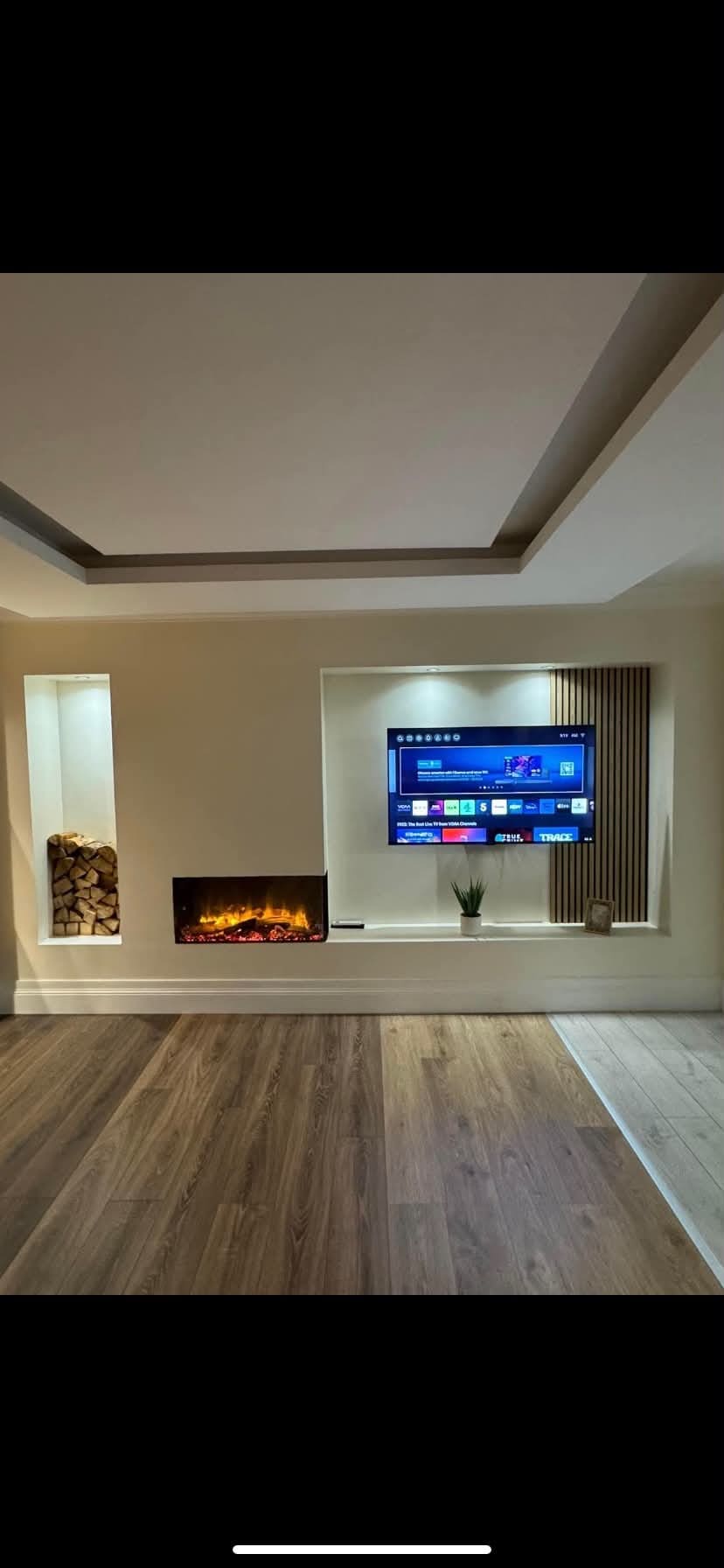
TV viewing angles in a corner room
Before committing to a corner design, think carefully about where you sit when watching TV. The ideal position puts the centre of the screen roughly at seated eye level, with your main seating directly in front. That said, in a corner room, one side of the seating area will often see a slightly angled view regardless of how the wall is built.
A full-motion swivel TV bracket helps here — it lets you angle the screen towards you wherever you’re sitting. If you plan to use one, tell your installer before the build starts: the framework needs to accommodate the extended arm clearance behind the panel, which adds a few extra centimetres of depth.
Find out more about our TV media wall installations across Sheffield and South Yorkshire.
The frame: what’s different in a corner build
Corner media walls need more structural planning than flat walls. A few things to be aware of:
- The corner junction: Where two panels meet, the frame needs to handle the turn cleanly. Metal stud (C-channel) framing manages this well. Timber framing can be used but requires precise mitre cuts at the corner.
- Fire placement: If you’re including an electric fire, it almost always works better on the main flat panel — not at the corner itself. A corner-mounted fire can look unusual and creates awkward ventilation geometry.
- Depth and room intrusion: Corner builds tend to intrude a little more into the room than straight walls, especially once a fire opening and any storage are factored in. Worth discussing the frame depth with your installer before the build to avoid the finished wall feeling too large for the space.
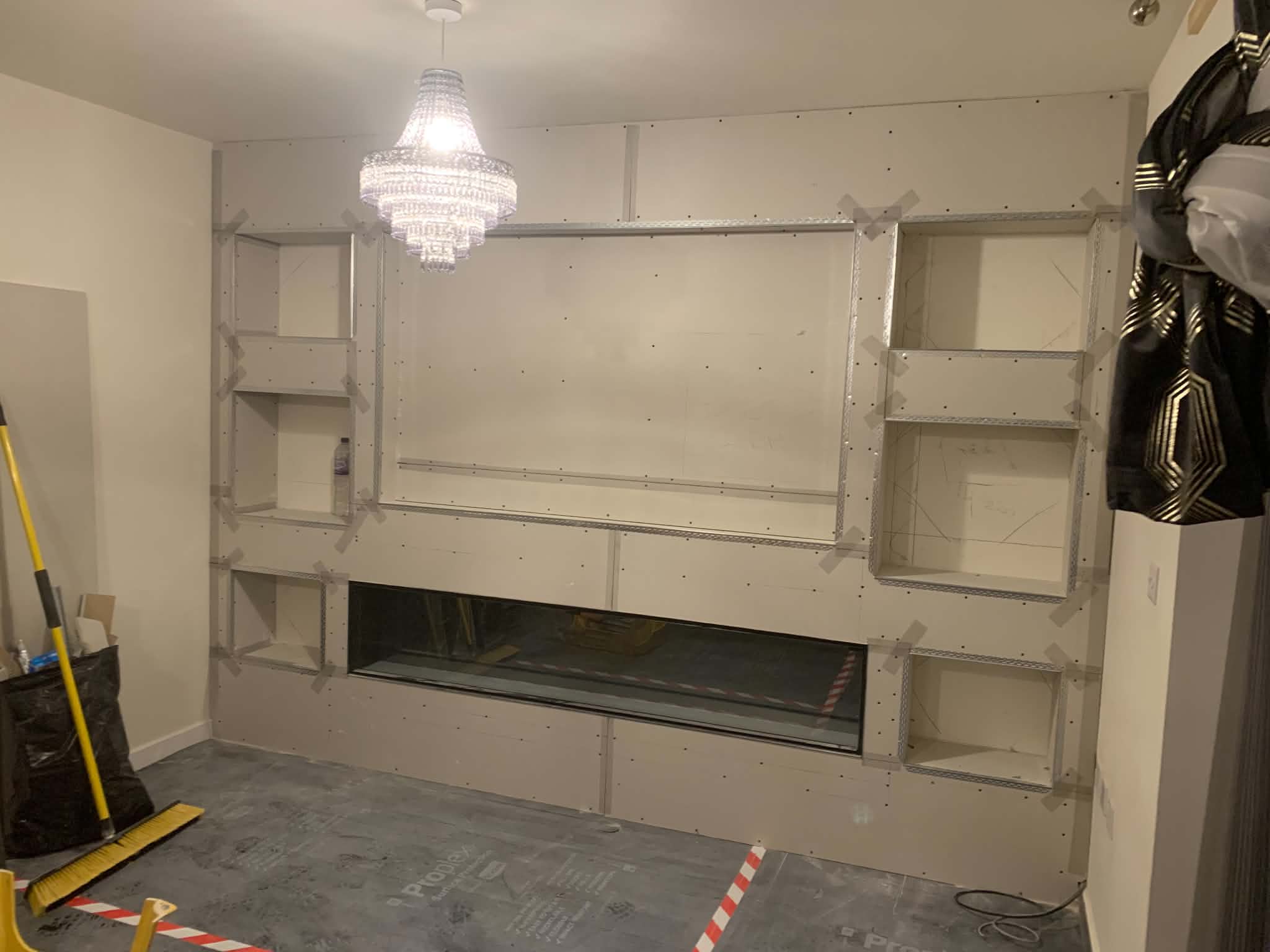
Design options for a corner media wall
Clean return, no storage
The simplest option: the main panel holds the TV and fire, and a slim return wraps onto the adjacent wall to give a clean, finished edge. Low room intrusion and a straightforward build — good for smaller rooms where you don’t want the wall to dominate.
Corner wall with alcoves
If you have an adjacent chimney breast, recess, or simply want to make more use of the corner, the return panel can incorporate built-in shelving or display niches. This makes the corner feel purposeful rather than boxy and adds practical storage or styling space.
Full wrap
Some designs run the wall surface fully across both walls, creating a larger installation that spans the whole corner. This works well in open-plan spaces where the corner becomes a natural zone or room divider. It’s the most involved build and uses the most material, but the result can be striking.
Finishing a corner media wall
The finish needs to work at the junction between the two wall surfaces. A few things to consider:
- Painted MDF or plasterboard: Works well around corners — paint wraps naturally, and the corner can be taped, filled, and sanded before painting. Use an angle bead on any external corner to prevent chips and cracking over time.
- Stone-effect cladding panels: These require a corner strip or trim at the junction to avoid an exposed cut edge. Ask your installer how they plan to handle it before you choose the panel.
- Oak or grey slatted panels: Look great on flat sections, but need a matching corner profile to finish neatly at the junction. This is usually a proprietary corner piece from the panel supplier.
What to tell your installer when enquiring
To give you an accurate layout and fixed quote, we need a few details when you get in touch:
- Which wall the TV will mainly face — and where your seating is positioned
- Whether you want a fire (and if so, whether you’re thinking electric inset or decorative effect)
- The approximate width of both walls at the corner — rough measurements are fine
- Whether there’s a chimney breast or recess involved
- How much room depth you can afford to lose
A photo of the corner from standing height — and one from where you normally sit — gives us most of what we need to suggest a layout. We’ll come back with a design idea and a fixed price.
Frequently asked questions
Can the TV go at 45 degrees on a corner media wall?
It can, but it limits your bracket options and often means some seats in the room get an awkward viewing angle. Most installers — including us — recommend keeping the screen on a flat panel and using a full-motion bracket for any fine-tuning.
Does a corner media wall cost more than a standard flat wall?
Yes, usually a little. The more complex framework and the additional finishing at the corner junction typically add to the build time and materials. The difference depends on the design — ask for a fixed quote once your installer has seen the space.
Will it make the room feel smaller?
It can, if the design is too bulky. A slim return with no storage adds very little depth. A full wrap is more substantial. Share your room dimensions when you enquire — we’ll flag it if a design looks likely to feel too large for the space.
Can a corner media wall include an integrated fireplace?
Yes — we build corner media walls with integrated electric fires regularly. The fire works best positioned on the main flat panel rather than at the corner itself. Our team will advise on placement during the design consultation.
Ready to get a quote?
Send a photo of your corner and your TV size (and whether you want a fire) and we’ll come back with a layout idea and a fixed price.
Or call 07477 405 111 / email dan@mediawallmaster.co.uk